

Buying a leisure battery based on budget alone, or simply matching what came with your caravan or boat, often leads to disappointment down the line. Too small, and you'll be searching for a plug socket halfway through your trip. Too large, and you're paying for capacity you'll never use. So, what size leisure battery do you actually need? It comes down to working out how much power your appliances draw, how long you'll be running them, and how many days you need to go between charges.
Understanding amp-hours
Leisure battery capacity is measured in amp-hours (Ah), which describes how much current a battery can supply over time. A 100Ah battery, for example, can theoretically deliver 100 amps for one hour, or 1 amp for 100 hours, though real-world usage rarely runs a battery down to empty.
It's also worth knowing that different chemistries offer different usable capacity. As a general sizing rule, it's common to allow for around 50% usable capacity from lead-acid or AGM batteries, while LiFePO4 batteries typically allow 80% or more of their rated capacity to be used, depending on the manufacturer. This difference matters enormously when you're sizing a battery, as two batteries with the same rated capacity can offer very different amounts of usable energy.
Calculating your daily power usage
The most reliable way to size a battery is to add up the power draw of everything you plan to run, then work out how long you'll use each item per day.
Start by listing your appliances and their wattage or amp draw, which is usually printed on the appliance itself or in its manual. Multiply the amp draw by the number of hours you'll use it each day to get the amp-hours required for that appliance. Add these figures together across everything you plan to run, from lighting and water pumps to fridges, chargers and entertainment systems, to reach your total daily amp-hour requirement.
From there, decide how many days of autonomy you want, meaning how long you need to run without recharging via mains hook-up, solar or your vehicle's alternator. Multiply your daily usage by the number of days, then divide by your battery's usable capacity percentage to find the battery size you actually need.
A worked example
Let's say a weekend away involves the following daily usage:
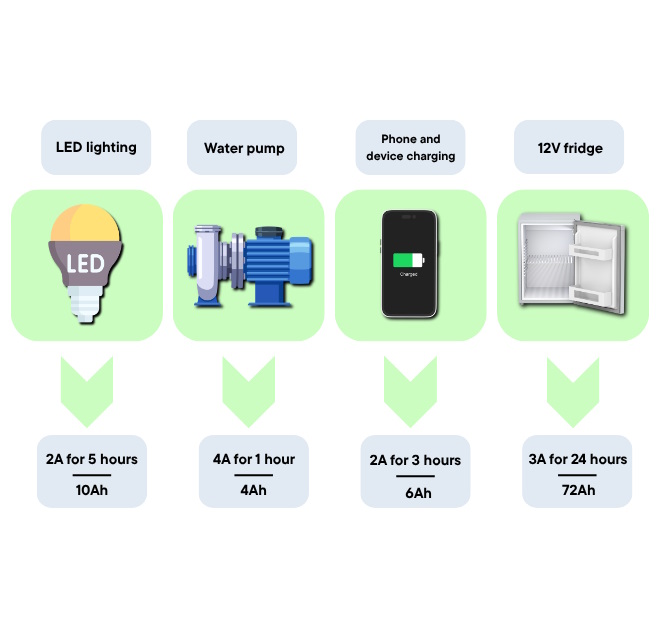
- LED lighting: 2A for 5 hours = 10Ah
- Water pump: 4A for 1 hour = 4Ah
- Phone and device charging: 2A for 3 hours = 6Ah
- 12V fridge: 3A for 24 hours = 72Ah
That totals 92Ah of daily usage. If you want two days of autonomy without recharging, that's 184Ah required in total.
For a lead-acid or AGM setup, where you'd only use around 50% of the rated capacity, you'd need a battery rated at roughly 368Ah to comfortably cover that usage, which in practice would mean two or more batteries wired together. For a lithium setup, where you can safely use around 80% of the rated capacity, a single 230 Ah battery would meet the same requirement with far less bulk and weight.
This is exactly why so many caravan, motorhome and boat owners are moving towards lithium as their power needs grow. It isn't just about a longer lifespan; it's about getting more usable energy from a smaller, lighter unit. If you're powering a boat specifically, our Marine page covers the additional factors, like vibration resistance and onboard charging, worth weighing up alongside sizing.
Other factors to consider
Beyond raw capacity, a few other things affect the right size battery for your setup.
Charging sources matter just as much as the battery itself. If you're relying on solar panels or a vehicle's alternator to top up between uses, your battery needs to be sized so it can be fully replenished within the time available, not just sized to last as long as possible on a single charge. Our Solar Systems page has more on matching panel output to battery capacity if you're planning a solar top-up setup.
Physical space and weight limits can also rule certain sizes out, particularly in smaller caravans, campervans or boats where every kilogram and every centimetre of locker space counts. Lithium's higher energy density often makes it the practical choice when space is tight.
Future-proofing is worth factoring in too. If you're likely to add appliances, upgrade to a bigger fridge, or extend your trips over time, sizing slightly above your current calculated need can save you from having to replace the battery again sooner than expected.
Getting the sizing right from the start
Getting your leisure battery size right from the outset saves money, hassle and the frustration of running out of power at the wrong moment. If you're weighing up capacity, chemistry or which setup suits your usage best, take a look at our Leisure page to find the right battery solution for your application, or get in touch with our team for tailored sizing advice.