

Do you rely on a leisure battery to keep the lights on, the fridge running or other appliances powered while you are away from home? If so, you will know how frustrating it can be when performance starts to decline.
So, how long does a leisure battery last? As a general guide, a leisure battery can last around three to ten years or more. The exact lifespan depends on the battery chemistry, how often and how deeply it is discharged, how it is charged and how well it is maintained.
Typical lifespan by battery type
Leisure batteries are not all built the same way, and lifespan varies considerably between chemistries.
Lead-acid batteries are one of the most affordable options and will often provide around three to five years of service when used and maintained correctly. Cycle life varies by model and depth of discharge, but repeated deep discharges generally shorten their lifespan.
AGM (Absorbent Glass Mat) batteries are sealed lead-acid batteries designed to cope well with vibration and demanding applications. A typical AGM leisure battery may last around four to seven years, depending on the battery, charging regime and depth of discharge.
Lithium iron phosphate (LiFePO4) batteries generally offer the longest lifespan. Many can provide several thousand charge cycles and may last eight to ten years or longer. They cost more upfront, but their longer cycle life, lower weight and greater usable capacity can make them cost-effective over time.
What shortens a leisure battery's life?
Even a high-quality battery can wear out prematurely if it is regularly pushed beyond its recommended operating conditions.
Deep discharges are particularly hard on lead-acid batteries. Frequently using a large proportion of the battery's capacity can reduce the number of cycles it delivers. Lithium batteries cope with deeper cycling much better, but depth of discharge still affects cycle life, so avoiding unnecessary full discharges can help maximise longevity.
Poor charging habits can also cause damage. Leaving a lead-acid battery partially discharged for long periods can encourage sulphation, where lead sulphate crystals build up on the plates and reduce usable capacity. Persistent overcharging can also damage a battery through excess heat and unwanted chemical reactions.
Using the wrong charger is another common problem. The charger should have a charging profile suitable for the battery chemistry and follow the manufacturer's recommended settings.
Extreme temperatures matter too. Excessive heat accelerates battery ageing, while low temperatures can temporarily reduce performance. Lithium batteries need particular care in cold conditions, as many LiFePO4 batteries should not be charged below their specified minimum charging temperature unless suitable protection or heating is fitted.
Care tips to extend battery life
A few simple habits can help you get more reliable service from your leisure battery.
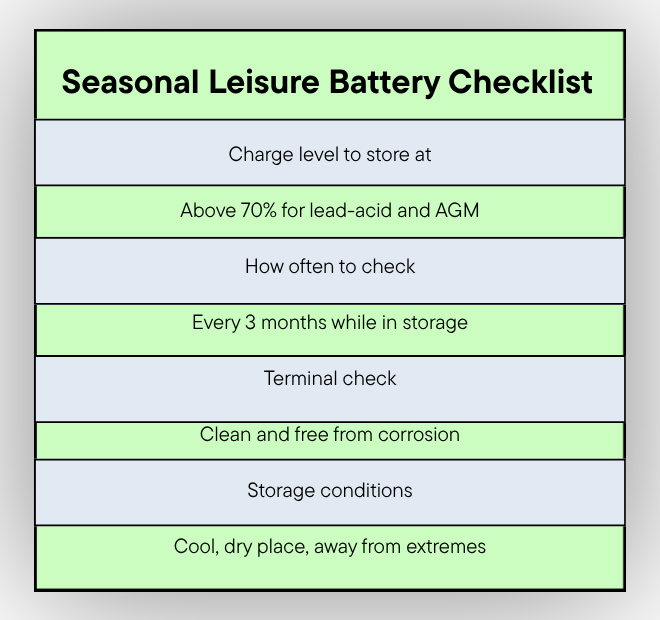
Avoid leaving the battery discharged for long periods, particularly during winter storage. Follow the manufacturer's storage guidance and check the battery periodically when your caravan, motorhome or boat is not being used.
Match your charger to the battery type. Lead-acid, AGM and LiFePO4 batteries have different charging requirements, so make sure your mains charger, solar controller and DC-to-DC charger are compatible with your battery.
Keep terminals and connections clean and secure. Poor connections can increase resistance and reduce charging efficiency. Periodic checks can also help you spot loose terminals, damaged cables or corrosion early.
Avoid mixing old and new batteries in the same bank unless the manufacturer specifically permits it. Differences in age, capacity and internal resistance can lead to uneven charging and discharging.
It is also worth monitoring the state of charge. A suitable battery monitor can help you understand how much energy you are using and reduce the risk of repeatedly over-discharging the battery.
Getting the right battery for your needs
Battery lifespan starts with choosing the right battery for the job. Whether you are powering a caravan, motorhome or boat, the best option depends on how much energy you use, how often you travel, how you recharge and the space and weight available.
Choosing the right battery chemistry and capacity, then pairing it with a suitable charging system, can make a significant difference to both lifespan and day-to-day reliability.
Take a look at our Leisure page to find the right battery solution for your application, or get in touch with our team for tailored advice on choosing and maintaining the right leisure battery for you.